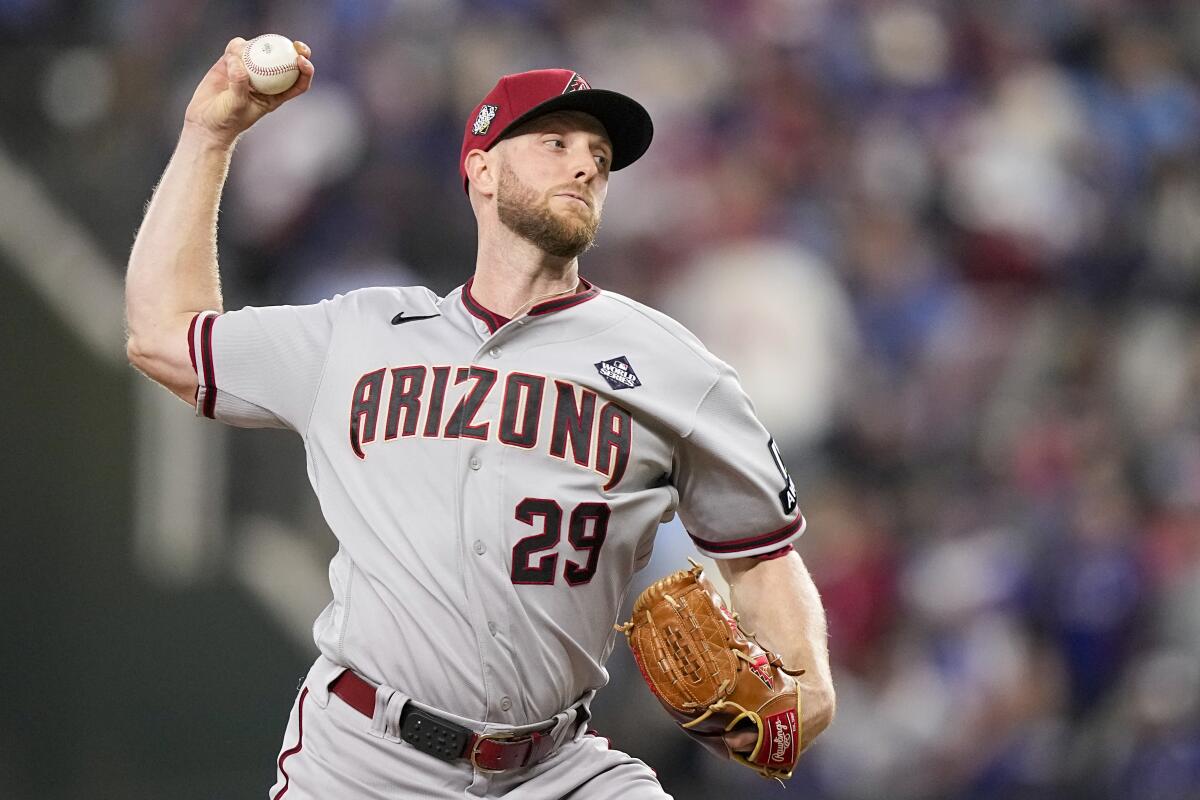
Multiple reports surfaced early this morning indicating that the Arizona Diamondbacks have brought back veteran starting pitcher Merrill Kelly on a two-year contract. The agreement is reportedly worth $40 million, a figure that has raised eyebrows across the league. Not only does it exceed most external projections for Kelly’s market value, but it also appears to push the Diamondbacks beyond what many assumed would be their comfort zone in terms of spending this offseason.
Still, the move represents a familiar reunion. Kelly’s return to Arizona closes a short but notable chapter away from the organization. After spending the majority of his major league career with the Diamondbacks, Kelly was dealt to the Texas Rangers at the trade deadline earlier this year. Now, just months later, he’s back in the desert—bringing stability, experience, and reliability to a rotation that suddenly looks far more settled than it did just a week ago.

Kelly’s journey to this point has been anything but conventional. He originally joined the Diamondbacks in 2019 after resurrecting his career overseas in the Korea Baseball Organization, where he reinvented himself following years of bouncing around professional baseball without a true foothold in the majors. What followed in Arizona was one of the most quietly productive pitching tenures in franchise history. Over the better part of seven seasons, Kelly became a dependable presence in the rotation, providing innings, leadership, and consistency at a cost that, in hindsight, looks like a bargain.
That’s part of what makes the new contract notable. At $40 million over two years, this deal represents a significant raise compared to what Kelly earned during his first stint with the team. It also surpasses many public forecasts. MLB Trade Rumors, for example, had pegged Kelly closer to $36 million over two seasons, and there had been a prevailing belief that Arizona might ultimately be priced out of the market if bidding escalated. That assumption clearly proved incorrect.
Rather than losing Kelly to another organization, the Diamondbacks opted to stretch financially and secure a pitcher they know well. While there doesn’t appear to be much of a “hometown discount” involved this time around, it’s difficult to argue that Kelly hasn’t earned it. For years, he provided strong value while being paid well below market rate. This contract, in many ways, serves as a correction—bringing his earnings more in line with his on-field contributions.
The timing of the signing is also important. Coming on the heels of Arizona’s recent agreement with Michael Soroka earlier in the week, Kelly’s return effectively solidifies the club’s projected Opening Day rotation. As things currently stand, the Diamondbacks appear set to enter the season with the following five starters:
- Merrill Kelly
- Eduardo Rodríguez
- Ryne Nelson
- Brandon Pfaadt
- Michael Soroka
That group offers a mix of experience, upside, and durability. Kelly and Rodríguez provide veteran anchors at the top, while Nelson and Pfaadt continue to develop into reliable mid-rotation arms. Soroka, meanwhile, represents a low-risk, potentially high-reward addition whose health will largely determine his role and impact.
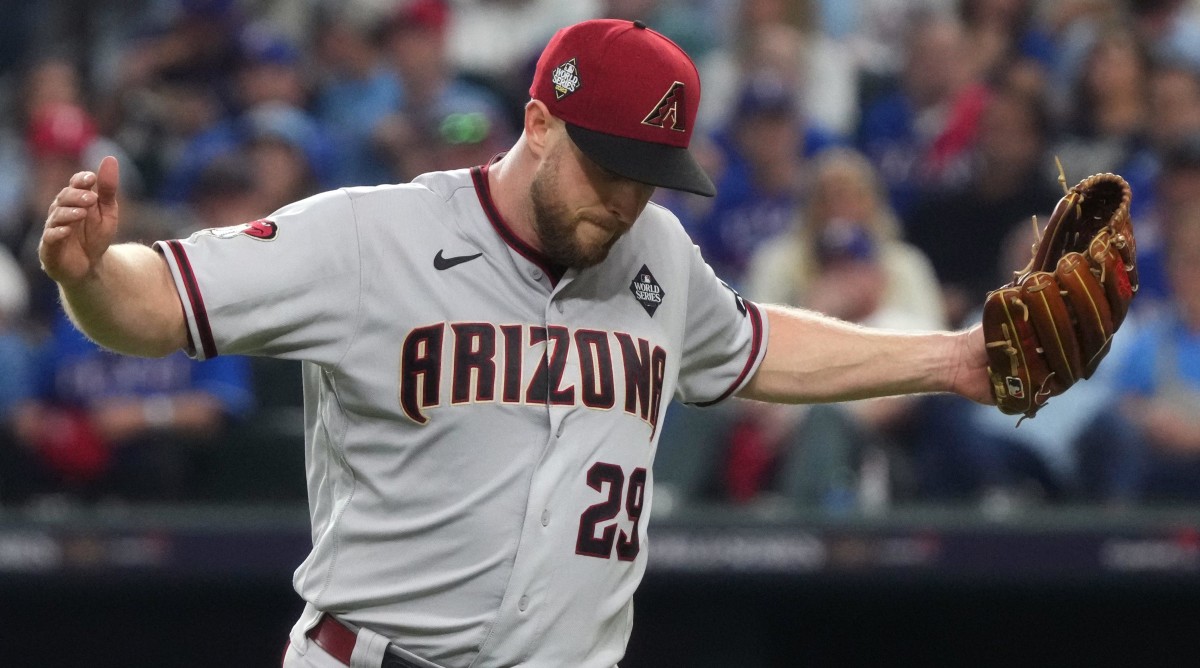
There is also the looming presence of Corbin Burnes, whom the team expects to rejoin the rotation at some point during the upcoming season. Assuming Burnes returns to form and the rest of the group remains healthy—a significant assumption in any pitching discussion—Arizona could find itself with more starting options than available rotation spots. In that scenario, Soroka would likely slide into a long relief or swingman role, giving the Diamondbacks valuable depth while preserving flexibility.
Of course, pitching depth is rarely a bad thing. Injuries, workload management, and performance fluctuations tend to resolve any perceived surplus fairly quickly. Still, Kelly’s signing provides clarity. For the first time this offseason, the Diamondbacks have a fairly defined picture of what their rotation will look like heading into spring training.

With that piece now in place, attention is expected to shift toward the bullpen. General manager Mike Hazen has been transparent about his desire to upgrade the relief corps, which was an area of inconsistency last season. The question is no longer whether the Diamondbacks want bullpen help, but rather how they intend to acquire it given the current financial picture.
While the full details of Kelly’s contract have not yet been released, a straightforward assumption would place his annual salary at roughly $20 million. When combined with Soroka’s deal, Arizona has added approximately $27.5 million to its payroll in just the past week. That figure alone could represent a sizable portion—if not the majority—of the remaining budget Hazen has available this winter.

If that’s the case, it would suggest that trades, rather than additional free-agent signings, may be the primary avenue for further roster improvement. With the starting rotation now largely locked in, the likelihood of dealing a major core piece—such as Ketel Marte—appears to diminish. Marte has long been viewed as one of the team’s most valuable and versatile players, and solidifying the pitching staff reduces the urgency to move him for rotation help.

Instead, Arizona may look to move smaller, more expendable assets to address bullpen needs. Outfielders like Jake McCarthy or Alek Thomas could become trade chips, particularly if the organization believes it has sufficient depth at those positions. Packaging one of those players for a controllable relief arm might offer a cost-effective way to bolster the bullpen without further straining the payroll.
The financial implications of Kelly’s contract are impossible to ignore, but so too is the value he has provided—and could continue to provide—on the field. Over seven seasons with the Diamondbacks, Kelly accumulated 15.9 wins above replacement (bWAR) while earning a total of just $38.5 million. In other words, Arizona paid roughly $2.4 million per WAR during that stretch, an extraordinary return by modern standards.

This new deal goes a long way toward evening out that ledger. Using the commonly cited estimate that one win on the open market is worth approximately $11 million, Kelly would need to produce around four WAR combined over the two seasons of the contract to justify the investment. That’s a very attainable benchmark, particularly given his track record.
FanGraphs currently projects Kelly for approximately 2.5 WAR next season alone. If he comes anywhere close to that number in 2026 and remains a league-average to slightly above-average starter in 2027, the contract would likely be viewed as a success. Even modest regression wouldn’t necessarily make the deal a failure, especially when factoring in his leadership, familiarity with the organization, and ability to provide innings in an era where durability is increasingly rare.

There is, of course, an unavoidable note of uncertainty hovering over the latter years of the contract. Beyond the usual concerns about age and health, there are broader questions about the long-term stability of the league itself. With ongoing labor tensions and the expiration of the current collective bargaining agreement looming, it’s fair to wonder what the 2027 season might look like—or whether it will happen at all.
That uncertainty doesn’t diminish the logic behind the signing, but it does add another layer of risk. Still, from the Diamondbacks’ perspective, bringing back a known commodity at a time when pitching prices continue to soar may be the safer bet. Kelly has proven he can succeed in Arizona, adapt when necessary, and deliver value well beyond his paycheck.
In the end, this deal feels less like an overreach and more like a calculated decision to reward reliability. Merrill Kelly may not generate headlines the way elite aces do, but he has consistently delivered results—and now, finally, he’s being paid closer to what those results are worth.