The answer to the final missing piece of the St. Louis Cardinals’ offseason puzzle might not require a splashy signing or a last-minute trade. It could already be sitting in camp, quietly waiting for an opportunity.
For months, Cardinals President of Baseball Operations Chaim Bloom has emphasized one particular need: a veteran, right-handed-hitting outfielder who can lengthen the lineup and balance out the roster. The front office has explored familiar names, including Andrew McCutchen, Tommy Pham, and Randal Grichuk — experienced bats who could theoretically slide into the final spot on the 26-man roster. Each would bring a track record, leadership, and some degree of stability. But while those options remain on the table, there’s another candidate whose name hasn’t generated nearly as much buzz — and yet he might have a more realistic path to making an impact in 2026 than many expect.
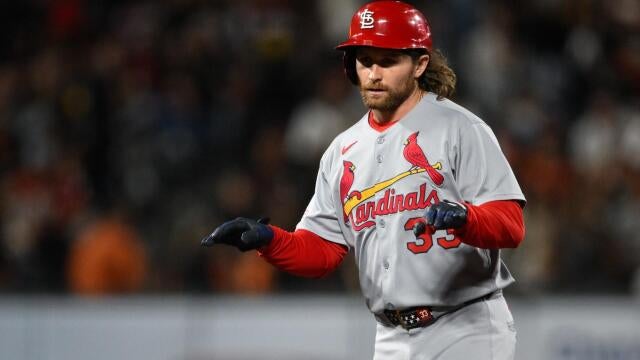
According to a recent MLB.com analysis, Nelson Velázquez has emerged as a legitimate contender to crack the Cardinals’ Opening Day roster. On the surface, he looks like a depth option — the type of player who competes hard in spring training, provides insurance at multiple spots, and perhaps rides the Memphis-to-St. Louis shuttle as needed. But circumstances and skill set could align in a way that gives him a far more significant role.
Brian Murphy of MLB.com pointed to Velázquez’s raw power as a trait that fits what the Cardinals have been missing. Over the last several seasons, St. Louis has struggled to generate consistent, game-altering power production. Nolan Arenado and Paul Goldschmidt, long counted on as middle-of-the-order anchors, have not delivered the dominant home run totals that once defined their reputations. While both remain respected veterans, the Cardinals’ offense has lacked the kind of thunder that can flip a game with one swing.
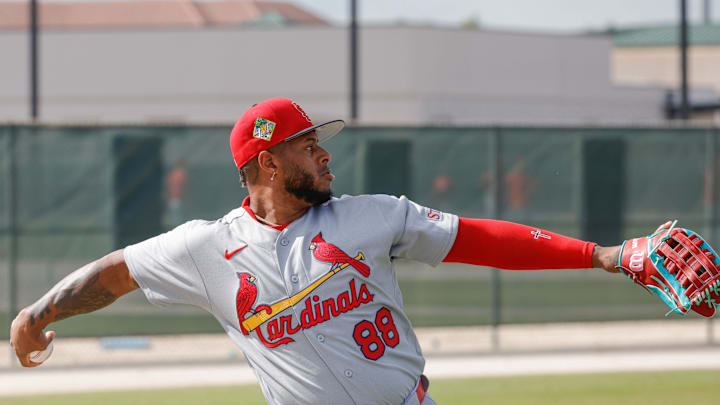
Velázquez, for all his flaws, undeniably possesses that kind of pop.
In 194 major league games split between the Chicago Cubs and Kansas City Royals, Velázquez has launched 26 home runs. That’s not an eye-popping total at first glance, but it reflects legitimate power in limited opportunities. When given consistent at-bats, he has demonstrated the ability to punish mistakes. His 2025 season in Triple-A reinforced that reputation — he crushed 11 home runs in just 51 games, showcasing the kind of strength that can’t be taught.
Of course, there’s a reason Velázquez has bounced between organizations and the majors and minors. Like many power-first hitters, his offensive profile comes with a significant drawback: getting on base consistently has been a challenge.

In 2025 with Kansas City, he hit just .200 and posted a .274 on-base percentage. Those numbers underscore the concern. Strikeouts and streakiness have limited his overall value at the major league level. Big power doesn’t carry quite as much weight if it’s paired with prolonged slumps and limited plate discipline.
Yet Velázquez’s performance outside of MLB competition complicates the narrative. In the Mexican League last season, he thrived — slashing .317 with a .444 on-base percentage. That jump suggests that when he’s locked in and seeing the ball well, he’s capable of more than just occasional home run bursts. The question is whether the Cardinals’ coaching staff can help him translate that success against top-tier pitching.
It’s not the likeliest outcome, but it’s not impossible either.
And roster dynamics could quietly work in his favor.

Lars Nootbaar’s health status looms as a significant storyline heading into the season. Recovering from surgery on both feet, Nootbaar’s availability for Opening Day remains uncertain. Even if he’s ready, questions about durability could linger. Meanwhile, Alec Burleson is expected to spend more time at first base after primarily playing the outfield in recent seasons. That positional shift could leave left field more open than originally anticipated.
Suddenly, what seemed like a fully accounted-for depth chart doesn’t look quite so settled.
If Velázquez impresses during spring training — showing improved discipline, controlled aggression, and perhaps more consistent contact — he could capitalize on that opportunity. A strong camp performance might position him as more than a bench bat. It could earn him meaningful early-season at-bats, especially if injuries or roster shuffling create space.
There’s also the longer-term consideration. While nothing is guaranteed, Nootbaar’s future with the organization isn’t entirely set in stone. If the Cardinals fall out of contention or decide to pivot at the trade deadline, discussions around controllable assets could arise. Should Nootbaar be moved — again, a hypothetical rather than a certainty — that would open an even larger window for Velázquez or another internal option.
Velázquez’s age works in his favor as well. At 27, he’s no longer a raw prospect, but he’s also not past his prime. He’s entering what should be his physical peak years, a period when players often refine their approach and maximize their tools. Sometimes it takes a few stops and a bit of organizational patience for a player’s skill set to click.
Importantly, Velázquez stands out among this year’s non-roster invitees. He is the only player in that category with meaningful major league experience. That background gives him a slight edge — he’s faced MLB pitching, navigated big-league clubhouses, and understands the pace of the game at its highest level. For a Cardinals team trying to blend youth with stability, that experience matters.
The organization is also evaluating younger outfielders like Joshua Baez, whose long-term upside may exceed Velázquez’s. However, Baez and others still need development time. Velázquez could serve as a capable bridge — someone who fills innings and absorbs pressure while prospects continue to mature. He doesn’t need to become a star to provide value; he simply needs to deliver enough production to justify consistent playing time.
Thomas Saggese and Jose Fermin are also part of the mix, but neither brings the same pure power potential. Velázquez’s calling card is clear. When he connects, the ball travels. In a lineup searching for more extra-base damage, that trait shouldn’t be dismissed lightly.
Financial considerations add another layer. The Cardinals are operating with an eye toward cost control, limiting major external expenditures. Signing a veteran free agent to fill the final roster spot would require additional payroll flexibility. If the front office believes internal options can approximate that production at a lower cost, the incentive to look outside diminishes.
Manager Oli Marmol has already signaled that the team may not be desperate to import a right-handed bat from outside the organization. That vote of confidence — even if measured — suggests that the coaching staff sees potential within the current pool of players.
In that context, Velázquez begins to look less like a longshot and more like a pragmatic solution.
He wouldn’t need to carry the offense. He wouldn’t be asked to anchor the lineup. But as a complementary piece — someone who can provide occasional fireworks, spell starters, and take advantage of favorable matchups — he could carve out a meaningful role.
For the Cardinals, the upcoming season represents something of a reset. They are attempting to reestablish credibility after underwhelming stretches and recalibrate expectations. The climb back toward consistent contention may not be immediate. Stopgap contributors, undervalued assets, and internal breakthroughs will all play a role in that process.
Velázquez embodies that type of gamble: low financial risk, moderate upside.
If he struggles, the Cardinals can pivot. If he thrives, they gain affordable power at a time when they desperately need it.
Spring training will serve as the proving ground. Approach at the plate, defensive reliability in the outfield, and overall consistency will determine whether he’s simply organizational depth or a legitimate roster piece. The margin between those two outcomes can be thin.
Sometimes the solution to a roster question isn’t the flashy acquisition fans anticipate. Sometimes it’s a player already in uniform, waiting for alignment between opportunity and performance.
For the Cardinals, that alignment could involve Nelson Velázquez. Whether he becomes a temporary fill-in or something more substantial will depend on adjustments, health, and timing. But as the club searches for the final component of its offseason construction, the answer might not require looking beyond its own clubhouse.