
The Los Angeles Dodgers accomplished something seldom seen in modern baseball: they secured back-to-back World Series championships, completing a season overshadowed by scrutiny, noise, and constant conversation about their spending habits. Their run was historic, but it unfolded under a microscope. From Opening Day onward, the Dodgers lived with expectations that few teams in the sport ever carry, and they were reminded of those expectations every step of the way.
This past offseason had been one of the most heavily discussed in the franchise’s long and decorated history. After the front office shocked the baseball world by landing Shohei Ohtani, arguably the most uniquely talented player ever to step on a diamond, they doubled down by signing Yoshinobu Yamamoto, the top pitcher available on the international market. Instead of stopping there, the Dodgers kept adding established stars and impact pieces, aggressively building a roster that looked on paper almost unfair. Naturally, such an approach dominated the narrative heading into the season. As camps opened and spring training began, most analysts labeled Los Angeles the prohibitive favorite to win it all. The expectations were not theoretical; they were universal.
But heavy spending comes with heavy backlash. The Dodgers’ payroll, already among the highest in baseball, ballooned even further. Their strategy of deferring large portions of players’ salaries became a constant talking point among commentators, fans, and rival executives. Many argued that the team had essentially used its financial power to corner the top of the free-agent market. So even when Los Angeles validated the hype by winning another championship an achievement that, in most eras, would silence critics the criticism did not dissipate. If anything, it intensified.
Shortly after the Dodgers clinched their second straight title, former Philadelphia Eagles star and current podcast personality Jason Kelce voiced the opinion that many detractors had been repeating throughout the year. On his popular show, New Heights, Kelce vented his frustration, saying, “That’s why baseball sucks. You just buy World Series championships.” In his view, the Dodgers’ success was not rooted in shrewd development, teamwork, or organizational excellence, but rather in their ability to simply outspend everyone else.

Kelce’s comments echoed a widespread sentiment. Over the past several winters, Los Angeles had developed a pattern: target the biggest free agents, offer massive deals with heavy deferrals, and lean on ownership’s deep pockets to outmaneuver rivals. Many fans of small-market teams saw it as further proof that Major League Baseball lacked true parity. Yet Kelce’s remarks still made waves partly because of his public stature, and partly because they arrived so soon after the Dodgers’ triumph.
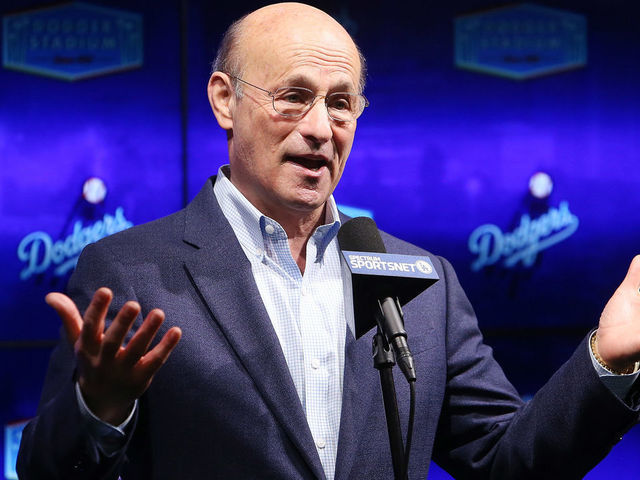
Those comments eventually caught the attention of Stan Kasten, the Dodgers’ president and one of their part-owners. Appearing on the Starkville podcast, Kasten made it clear that he was well aware of Kelce’s criticism and was more than ready to respond. With a measured but unmistakably pointed tone, he pushed back against the idea that money alone determines championships.
“Usually the team with the highest payroll doesn’t win the World Series,” Kasten said, rejecting the notion that financial might directly results in trophies. He went further, adding, “I hate to throw facts at him, but I will throw one quote from someone in his city, and that’s Bryce Harper, who said the only people complaining are losers. I think he’s exactly right.”

Kasten’s reply was not just a rebuttal it was a deliberately chosen counterpunch. By invoking Bryce Harper, he leaned on the credibility of a superstar who plays in Kelce’s own sports city. He also highlighted that even prominent players outside the Dodgers’ organization, including those on payroll-heavy teams like the Philadelphia Phillies, understood and respected the Dodgers’ approach.
Harper’s comments had come months earlier, just after Los Angeles had added Blake Snell, Tanner Scott, and Roki Sasaki to an already loaded roster. Even though Harper plays for a team that often finds itself compared financially and competitively with the Dodgers, he refused to join the chorus of critics. Instead, he defended the Dodgers’ willingness to invest in talent, calling it an admirable demonstration of ambition and organizational excellence.

“I don’t know if people will like this,” Harper told the Associated Press in April, “but I feel like only losers complain about what they’re doing. I think they’re a great team and a great organization.” His words were direct perhaps even blunt but they expressed a philosophy shared by many elite athletes: greatness recognizes greatness, and those striving to reach the top seldom resent others who do the same.
Ironically, Harper and the Phillies went on to experience another heartbreaking postseason. For the second straight year, Philadelphia entered October with championship aspirations, only to fall short. In the National League Division Series, the Phillies faced the Dodgers again, and once more Los Angeles proved to be the superior team. The Phillies managed to win a single game in the series, but the Dodgers advanced and ultimately captured another title. Despite that disappointment, there was no indication that Harper had reversed his stance. If anything, his earlier comments suggest he respects the Dodgers not only for their spending power, but for their consistency, discipline, and ability to maximize the talent they assemble.
This is the broader issue Kasten seemed to be addressing in his response: the idea that money may help build a roster, but it cannot guarantee chemistry, execution, or postseason success. Baseball is littered with examples of high-payroll teams that fell short. The Dodgers, on the other hand, have leveraged their spending intelligently by pairing it with outstanding player development, analytics, scouting, and organizational cohesion. Kasten’s message to Kelce delivered through Harper’s earlier remark—was essentially that winners understand the complexity of success, while oversimplified criticisms tend to come from those who do not.

It’s worth noting that Kasten’s decision to cite Harper specifically served multiple purposes. On the surface, using a comment from a Philadelphia athlete connected the rebuttal to Kelce’s hometown. Harper is also one of the most respected voices in the sport, and hearing his endorsement of the Dodgers carries more weight than hearing it from an executive. But there was another layer to the exchange: Harper’s use of the term “losers.” Kasten’s echo of that term was almost certainly intentional. He was not calling Kelce a loser directly, but he was highlighting the sharpness of Harper’s point that complaining about a team’s financial decisions rather than acknowledging their work ethic and achievements reveals more about the complainer than the team being criticized.
Viewed in full, the entire episode offers a snapshot of the broader debate surrounding the Dodgers’ modern identity. They are undoubtedly wealthy, and their financial resources allow them opportunities that many clubs simply cannot match. But they also operate with a level of sophistication and ambition that extends beyond signing big names. Their player development pipeline remains one of the strongest in baseball. Their scouting network uncovers international and domestic talent that other teams often overlook. Their coaching staff and performance departments are widely regarded as elite. Money gives them room for error, but skill, structure, and vision turn that advantage into results.
Still, for some fans and observers, perception is reality. To those who see the Dodgers as a monolith built on unchecked spending, their back-to-back championships symbolize a competitive imbalance rather than an organizational triumph. To others, the Dodgers represent the ideal model of a franchise willing to reinvest profits into winning teams instead of pocketing revenue. The divide in perspectives is unlikely to disappear, no matter how many facts are introduced or how many players like Harper vouch for the Dodgers’ legitimacy.
Nevertheless, the exchange involving Kelce, Harper, and Kasten highlights the tension that follows big-market teams in modern sports. Success brings celebration, but it also invites criticism. For the Dodgers, that dynamic has become routine. They are now positioned among the sport’s most polarizing teams not because of scandals or controversies, but because they win often and spend boldly.
In the end, Kasten’s response to Kelce was not merely a defense of his club’s strategy. It was a broader commentary on how greatness is perceived. To some, excellence is earned; to others, it is bought. The Dodgers, through their repeated success and their unapologetic pursuit of top talent, have become the focal point of that argument. And as long as they keep winning, the conversation however heated will undoubtedly continue.