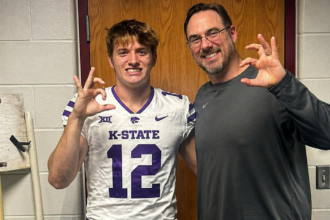
As the Mizzou winter recruiting window began to close and college programs scrambled to finalize their in-state boards, Graham Faust found clarity amid the chaos. While late offers and conversations continued to surface, the St. Louis native decided to take the next step in his football journey by committing to the University of Missouri. Faust, a safety from MICDS High School, verbally pledged to the Tigers as a preferred walk-on, solidifying his place in a recruiting class that has leaned heavily into keeping Missouri talent home.
Faust’s decision made him the fifth high school prospect from the Show-Me State to commit to Missouri within the same month, a reflection of the program’s renewed emphasis on local recruiting. Beyond geography, however, the commitment carried deep personal meaning. Missouri football has long been part of Faust’s identity, woven into his upbringing and family history. His father, Vic Faust, played tight end for the Tigers during the 1990s, giving Graham a lifelong connection to the program that ultimately felt impossible to ignore.

For Graham Faust, choosing Missouri was less about discovering a new opportunity and more about embracing one that had always been there. From his earliest memories, Mizzou athletics formed the backdrop of his childhood. Saturdays were spent in Columbia or glued to the television, following Tiger football and basketball with the kind of passion that only grows from tradition.
“Ever since birth, really,” Faust said when asked about his fandom. “I grew up going to Mizzou games — basketball, football — so I was all about Mizzou from the start. I grew up watching guys like Tyler Badie, Maty Mauk, all the originals. That’s just always been my school.”
That sense of familiarity made the recruiting process both exciting and challenging. Like many high school athletes, Faust had to balance childhood loyalty with the reality of evaluating where he truly fit at the next level. When Missouri director of scouting Jared Russell reached out on January 20, the conversation shifted from possibility to something tangible. The offer came as a preferred walk-on opportunity, but the discussions extended well beyond that label.

According to Faust, Missouri’s staff was transparent and thorough, outlining how his role could evolve as the roster takes shape heading into the 2026 season. Russell and the Tigers’ personnel department spoke in detail with Faust and his family about future compensation possibilities and financial aid options once scholarship numbers and roster balance allow for flexibility. The clarity and honesty of those conversations stood out in a process that can often feel vague or impersonal.
“When Coach Russell first started contacting me and reaching out, I started thinking to myself that I would love to go here,” Faust said. “At the same time, I wondered if maybe I was lowballing myself. But then I realized I can play with the big dogs, and I’m going to play with the big dogs. This just felt right. It was a dream come true — honestly, a full-circle moment.”

That belief in his own ability has been a defining trait of Faust’s journey. While he received multiple scholarship offers at the FBS and FCS levels, including from Air Force, Eastern Michigan, Miami (Ohio), and Missouri State, he remained focused on long-term development and competition rather than immediate guarantees. For Faust, Missouri represented both familiarity and the highest level of challenge.
His father, Vic Faust, echoed that sentiment while emphasizing how impressed he was with the Tigers’ evaluation process. Having navigated college football himself, Vic brought a seasoned perspective to the recruiting conversations, paying close attention not just to offers but to how programs viewed his son as a player.

“Their scouting staff is top notch, and I’m not just saying that because I’m a Mizzou guy,” Vic Faust said. “They talked specifically about where they see him, how he fits, and where he would have a real chance to compete with his talent. It was better than any conversation he’d had with other schools. They weren’t guessing — everything Graham knows about his abilities, they saw too. That meant a lot.”
Missouri’s interest in Faust was rooted in both production and projection. Standing 6-foot-3 and weighing 190 pounds, Faust possesses a frame that college strength programs covet, particularly in the secondary. His length, physicality, and instincts allow him to play downhill against the run while still holding his own in coverage. Those traits became even more impressive given the adversity he faced leading into his senior season.
Ahead of the summer before his final year of high school football, Faust suffered a knee injury that forced him to miss much of the offseason camp circuit. For many recruits, that absence can be costly, limiting exposure and delaying evaluations. Faust, however, responded by turning his senior season into a statement.
Despite missing key opportunities to showcase his skills in front of college coaches during the summer, he delivered a dominant fall performance that demanded attention. Competing in MSHSAA Class 5, Faust emerged as one of the most productive defensive players in the state. He finished the season with 94 total tackles, consistently serving as the backbone of MICDS’s defense. In addition to his tackling numbers, Faust recorded two interceptions, returned one for a touchdown, and added a fumble recovery, highlighting his ability to make impact plays in all phases.
Those performances helped him earn all-state honors, validating what Missouri’s staff had already identified on film. The Tigers saw not just a stat line, but a player who played with intelligence, toughness, and leadership — qualities that often separate contributors from depth pieces at the college level.

Faust’s athletic profile extends beyond football as well. At MICDS, he was also a standout lacrosse player, excelling as a two-way athlete with the speed, coordination, and field awareness to compete at a high level. His lacrosse ability generated interest from college programs, though he did not publicly report any formal offers. Still, that multi-sport background added another layer to his evaluation, reinforcing his versatility and competitive mindset.

For Missouri, that versatility fits neatly into a broader roster-building philosophy. Preferred walk-ons who bring size, athleticism, and a chip on their shoulder often carve out meaningful roles over time. Faust understands that nothing will be handed to him, but he embraces the challenge of earning his place within a Power Five program.
The commitment also reflects Missouri’s ongoing effort to strengthen its relationship with in-state high schools. By securing Faust — a legacy recruit with deep local roots — the Tigers continue to send a message that Missouri talent matters and that opportunities exist for players willing to develop and compete.
As Faust prepares for the transition from high school standout to college football newcomer, his focus remains grounded. He knows the road ahead will be demanding, filled with physical development, film study, and constant competition. But he also knows he is exactly where he wants to be.
For a kid who grew up wearing black and gold, watching Tiger greats from the stands, and hearing stories of Mizzou football at home, the decision feels both monumental and natural. What began as a childhood dream has now become a tangible opportunity — one built on perseverance, belief, and a program that saw his potential even when circumstances made it harder to see.
In the end, Graham Faust didn’t just choose Missouri. He chose continuity, challenge, and the chance to write his own chapter in a story that started long before his recruitment ever began.