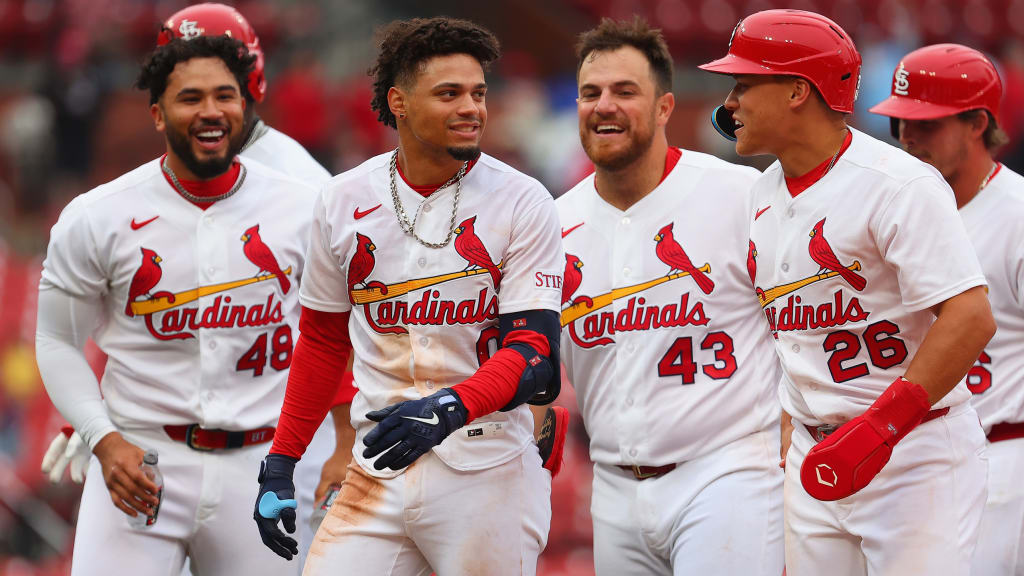
The St. Louis Cardinals are reportedly exploring the possibility of offering a long-term contract extension to their highly regarded young infielder, JJ Wetherholt, as part of a broader effort to reshape the franchise’s future. After making the deliberate decision to begin a rebuilding phase this season, the organization has shifted its focus away from established veterans and toward cultivating a new core of emerging talent.
This transition has not been subtle. The Cardinals moved on from several key contributors, including Brendan Donovan, Nolan Arenado, Sonny Gray, and Willson Contreras, signaling a clear organizational pivot. By parting ways with these established names, St. Louis has freed up both roster space and financial flexibility, creating an environment where younger players can step into prominent roles and develop at the major league level.

At the center of this youth movement is JJ Wetherholt, widely regarded as the Cardinals’ top prospect and one of the most exciting young players the franchise has produced in recent years. His arrival has already generated considerable buzz, and he wasted no time making an impression. In his very first game at the big-league level, Wetherholt launched a home run, an early glimpse of the offensive potential that has scouts and fans alike excited about his future.
Given his rapid rise and the organization’s current direction, it is not surprising that discussions about a long-term extension have surfaced. Reports suggest that Wetherholt is open to the idea of committing to St. Louis early in his career, especially as he watches other teams in the division take similar approaches with their own young stars. Both the Milwaukee Brewers and the Pittsburgh Pirates have recently secured key prospects with multi-year deals, reinforcing a growing trend across Major League Baseball: locking up elite young talent before they reach arbitration or free agency.

If the Cardinals were to pursue such a deal with Wetherholt, one projected framework could be an eight-year contract spanning from 2027 through 2034, valued at approximately $130 million. This estimate draws comparisons to a similar agreement signed by Roman Anthony, whose own eight-year, $130 million contract set a benchmark for top-tier prospects entering the league. Both Anthony and Wetherholt share several characteristics—they are highly ranked prospects with advanced skill sets and the potential to become cornerstone players for their respective franchises.
Another comparable situation involves Konnor Griffin, who is reportedly in line for a nine-year, $140 million deal with the Pirates. These types of contracts illustrate how teams are increasingly willing to invest heavily in young players, betting on their long-term value while gaining cost certainty and control over their prime years. For Wetherholt, such a deal could fall squarely within this emerging market range.

From the Cardinals’ perspective, offering a contract of this magnitude would represent a strategic move with several clear advantages. One of the most significant benefits would be cost certainty. By locking Wetherholt into a long-term deal early, the team could avoid the traditional progression through pre-arbitration and arbitration years, where salaries can escalate unpredictably based on performance. Instead, they would secure a fixed financial commitment, making long-term planning far more manageable.
Additionally, such a contract would extend the team’s control over Wetherholt beyond his standard service time, effectively buying out some of his potential free-agent years. This is particularly valuable if he develops into the star player many expect him to become. Securing those additional seasons could provide the Cardinals with a competitive advantage, allowing them to build a roster around a stable and productive centerpiece.

Financially, the timing could not be better for St. Louis. After shedding significant payroll over the past year, the organization has created room to absorb a contract like this without straining its budget. In fact, they could choose to structure the deal in a way that maximizes their current flexibility. For instance, they might front-load the contract, paying a larger portion of the salary in the earlier years when their payroll is relatively light. This approach would reduce financial pressure in later seasons, when the team may be more competitive and potentially carrying additional large contracts.
Beyond the financial and roster implications, extending Wetherholt would send a strong message about the franchise’s direction. It would signal a commitment to building around young talent and establishing a new identity following the departure of veteran players. For fans, it would provide a clear focal point—a player to rally around as the team navigates its rebuilding phase and works toward returning to contention.

On the other side of the equation, a long-term deal would offer significant advantages for Wetherholt himself. For many young players, the early years of a major league career come with financial uncertainty. Pre-arbitration salaries are typically modest, often below one million dollars annually, even for players performing at a high level. By agreeing to an extension, Wetherholt would immediately secure generational wealth, eliminating the risks associated with injury or performance decline.
A contract worth $130 million would place him among the highest-paid young players in baseball history, a remarkable achievement so early in his career. Instead of gradually increasing his earnings over several years, he would enjoy financial stability from the outset, allowing him to focus entirely on his development and performance without the added pressure of contract negotiations looming in the background.

Importantly, such a deal would not necessarily limit his long-term earning potential. If structured over eight years, it would still allow Wetherholt to reach free agency while he is in his late twenties or early thirties—typically considered a player’s prime. At that point, he could pursue another major contract, potentially capitalizing on both his performance and the rising market for elite talent.
There is also an emotional and professional aspect to consider. Signing an extension would represent a strong commitment to the organization that drafted and developed him. For many players, that sense of loyalty and continuity can be meaningful, providing a stable environment in which to grow and succeed. It would allow Wetherholt to establish himself as a foundational piece of the Cardinals’ future, rather than navigating the uncertainties of short-term contracts and potential team changes.

Of course, entering into a long-term agreement at such an early stage is not without its considerations. For Wetherholt, the primary trade-off is the possibility of earning even more money if he were to wait and prove himself over several seasons. If he performs at an elite level, his arbitration salaries and eventual free-agent contract could exceed the value of an early extension. However, this approach carries its own risks, including injury or underperformance, which could significantly impact his earnings.
For the Cardinals, the risk lies in committing a substantial amount of money to a player who is still in the early stages of his career. While Wetherholt’s talent is undeniable, there is always some level of uncertainty when projecting long-term performance. Nevertheless, this is a calculated risk that many teams are increasingly willing to take, given the potential rewards of securing a star player at a relatively controlled cost.

Ultimately, a deal between the Cardinals and Wetherholt would reflect a shared vision for the future. For the team, it would represent a cornerstone investment in their rebuilding efforts. For the player, it would provide security, opportunity, and a chance to grow into a leadership role within the organization.
As the landscape of Major League Baseball continues to evolve, early extensions for top prospects are becoming more common, reshaping how teams and players approach long-term planning. If the Cardinals and Wetherholt can reach an agreement, it could serve as a defining moment for both sides—one that sets the stage for a new era of success in St. Louis.
READ MORE