The Kentucky Wildcats didn’t have to look far to secure their next piece at tight end. Just down the road, Lexington Christian Academy standout Conrad Hart made his decision official on Friday, choosing to stay home and commit to Kentucky. His pledge gives the Wildcats another in-state prospect who embodies the size, physicality, and long-term upside that align with the program’s evolving identity.
Hart’s commitment carries weight beyond the feel-good “hometown kid stays home” narrative. At 6-foot-5 and 235 pounds, he already possesses the kind of frame coaches covet, paired with two-way production and a skill set that hints at significant growth potential. Rated as a three-star tight end, Hart offers more than just measurable traits—he brings versatility, toughness, and a competitive edge that stand out on film. Kentucky extended an offer on Thursday, and by Friday, Hart had made his choice. That quick turnaround speaks volumes about both the player’s interest and the program’s urgency in locking him in.
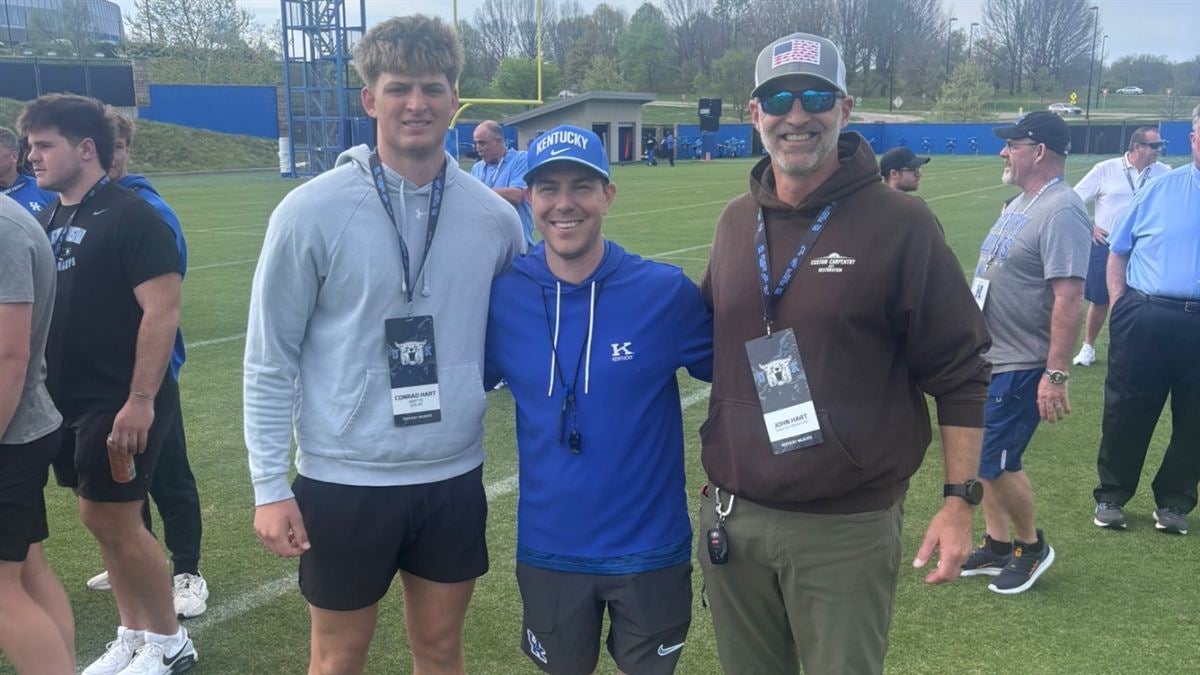
When Kentucky came calling, Hart didn’t hesitate. That decision reflects more than convenience—it reflects belief. He chose the Wildcats over a group of programs that included Army, Eastern Kentucky, Ohio, Toledo, Troy, and Western Kentucky. While those schools presented solid opportunities, Kentucky’s combination of SEC competition, proximity to home, and a clearly defined offensive role ultimately proved decisive. The chance to play at the highest level of college football while representing his home state was a compelling draw.
During his junior season at Lexington Christian Academy, Hart’s offensive numbers were modest but promising. He recorded 16 receptions for 190 yards and four touchdowns, showing flashes of his ability as a pass catcher, particularly in scoring situations. However, his overall profile becomes more intriguing when factoring in his defensive contributions. Hart registered 47 tackles, 4.5 tackles for loss, and two sacks—numbers that highlight his physicality, instincts, and willingness to engage in contact.

That defensive experience matters, especially at the tight end position in a league like the SEC. Tight ends in this conference are not simply receivers running routes—they are required to block defensive ends, establish leverage, absorb contact, and contribute in the run game. They must operate effectively in congested areas and capitalize on opportunities created through play-action. Hart’s background suggests he is well-equipped to handle those demands. His comfort with physical play and his understanding of leverage give him a foundation that should translate well at the next level.
What stands out immediately about Hart is not just his size, but how naturally his skill set fits into the offensive system being developed under Will Stein. This is not an offense that treats the tight end as an afterthought. Instead, it emphasizes tempo, spacing, and the ability to create mismatches across the field. Every skill position player is expected to stress the defense in some way—whether through speed, positioning, or physicality. Hart’s profile aligns with those expectations, making his commitment feel deliberate rather than incidental.

In this system, tight ends are used in a variety of ways. They are not confined to lining up next to the offensive tackle. Instead, they can flex out wide, operate from the slot, motion across formations, and create confusion for defenders. This versatility is where Hart’s potential becomes especially intriguing. While he is still developing as a receiver, he has shown enough ball skills and body control to project as a viable target down the seam and in the red zone—areas where explosive plays are often generated.
Yet, his fit goes beyond what he can do as a pass catcher. Stein’s offense places a premium on efficiency—staying ahead of the chains, making quick decisions, and forcing defenses to reveal their intentions early. For tight ends, that means embracing the less glamorous aspects of the position. Blocking effectively in the run game, sealing the edge, and transitioning smoothly into routes off play-action are all essential responsibilities. Hart’s defensive production underscores his readiness for this role. His ability to play with leverage, initiate contact, and compete physically suggests he can contribute early, even as he continues to refine other aspects of his game.

Perhaps the most compelling aspect of Hart’s commitment is his developmental ceiling. He is not entering college as a finished product—and that is precisely what makes him valuable in this context. Within Stein’s system, tight ends are developed over time. They often begin as role players—blocking specialists and situational targets—before evolving into multifaceted weapons who can dictate matchups.
Hart has the physical tools to follow that trajectory. His length, frame, and mentality provide a strong foundation for growth. As he adds strength and refines his technique, he has the potential to become a player who forces defenses into difficult decisions. Opponents may have to choose between matching his size with heavier personnel, risking being outpaced in coverage, or going smaller and potentially being overpowered in the run game. That kind of versatility is the ultimate goal.

Looking at the bigger picture, Hart’s commitment also strengthens the overall composition of Kentucky’s recruiting class. Pairing him with players like Jake Nawrot creates the potential for future on-field chemistry. A young quarterback benefits greatly from having a reliable tight end—someone who can operate effectively in the middle of the field, provide a safety valve, and contribute in multiple phases of the offense. Hart’s skill set positions him well to fill that role as both players develop.
Kentucky’s class already features notable talent, including Nawrot, defensive lineman Elijah Brown, and safety Tristin Hughes. These additions have helped elevate the Wildcats’ standing nationally, placing them among the top recruiting classes in the country. Within that group, Hart brings a different kind of value. He may not carry the same star rating as some of his classmates, but he offers intangibles that are equally important: toughness, versatility, and a deep understanding of what it means to represent the program.

There is also something to be said for players who grow up close to the program they eventually join. Hart understands the culture, the expectations, and the significance of wearing Kentucky’s colors. That familiarity can translate into a smoother transition and a stronger sense of accountability. He is not just joining a team—he is representing a community he already knows well.
In many ways, Hart embodies the type of player Kentucky is trying to build around. He is physically gifted but still developing, competitive but coachable, and versatile enough to fit multiple roles. His commitment is not just about filling a roster spot—it is about reinforcing an identity.
As Kentucky continues to shape its future, additions like Hart serve as foundational pieces. They may not always generate the loudest headlines, but they contribute to the structure and sustainability of the program. With the right development, Hart has the potential to grow into a key contributor—someone who reflects both the toughness of the SEC and the pride of his home state.
In the end, this decision represents more than just a recruiting win. It reflects alignment—between player and program, between potential and opportunity. Conrad Hart is staying home, and in doing so, he becomes part of something larger than himself. For Kentucky, that means adding another building block to a class defined not just by talent, but by purpose.
READ MORE