The St. Louis Cardinals find themselves in an interesting position as the 2026 season enters its final stretch. With the postseason still within reach and only a little more than 30 games remaining, the club has very little room for error. At the same time, St. Louis has several promising young players developing in the minor leagues who could potentially provide a spark at the major-league level.
The Cardinals have already shown a willingness to look toward their future while remaining in the playoff hunt. That became especially clear when the organization promoted outfielder Joshua Báez, its No. 3 prospect, to the majors. Báez immediately rewarded that decision by producing one of the most remarkable starts imaginable.
In his first game, Báez made MLB history by launching a home run in each of his first three plate appearances. The explosive performance instantly put his name in the spotlight and demonstrated why the Cardinals viewed him as one of the organization’s most exciting young talents.
However, Báez is not the only St. Louis prospect who could be ready to make an immediate impact.
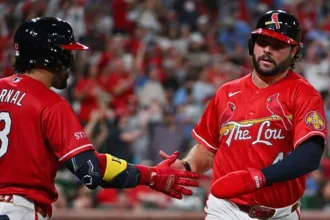
Another highly regarded player waiting in the wings is 22-year-old catcher Leo Bernal, the Cardinals’ No. 7-ranked prospect. Although St. Louis already has several catchers on its major-league roster, Bernal’s recent production has made it increasingly difficult to ignore the possibility of giving him an opportunity.
MLB.com’s Jim Callis, Sam Dykstra and Jonathan Mayo recently identified Bernal as the next Cardinals prospect who could receive a promotion. While there are legitimate reasons for St. Louis to hesitate, the team’s current catching situation should not automatically prevent Bernal from getting a taste of major-league baseball.

Bernal Has Earned a Chance
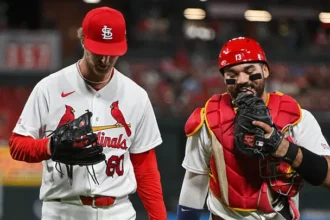
There is an obvious complication surrounding Bernal’s potential promotion: the Cardinals already have three young catchers in Iván Herrera, Pedro Pagés and Jimmy Crooks.
Ordinarily, carrying four catchers would make little sense, particularly for a team trying to maximize its roster flexibility during a playoff push. Catcher is also a position where consistent playing time is incredibly important for development. If Bernal were promoted only to sit on the bench, the move could potentially hurt rather than help his progress.
That is the strongest argument against bringing him up.
Still, Bernal’s recent performance has reached a point where St. Louis may need to at least consider whether the benefits outweigh the logistical problems.
Callis, Dykstra and Mayo pointed out that Bernal has already established a career high with 15 home runs at Triple-A Memphis. Even more encouraging is what he has done recently. Since the beginning of July, he has posted a .321 batting average, .384 on-base percentage and .598 slugging percentage across 29 games.
Those numbers suggest Bernal is not simply surviving against Triple-A pitching. He is actively dominating it.
For a young catcher, that kind of offensive production is difficult to overlook.

Bernal also brings an intriguing defensive tool to the table. His pop times can get down around 1.8 seconds, giving him the kind of throwing ability that could translate immediately to the major leagues. A strong arm is particularly valuable at catcher, where controlling the running game can have a major impact.
The Cardinals would therefore not be promoting a prospect solely because he has performed well with the bat. Bernal has a defensive foundation that could allow him to contribute behind the plate while continuing to develop offensively.
The Cardinals Already Have Three Catchers
The biggest obstacle standing between Bernal and a major-league debut is the Cardinals’ existing catching depth.
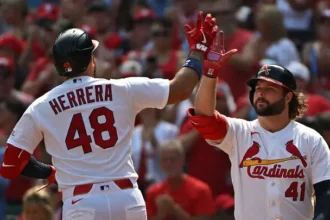
Herrera remains the most established offensive threat among St. Louis’ catchers. His bat has made him an important part of the lineup, but his role has increasingly extended beyond catching. The Cardinals have frequently used him as their designated hitter, meaning his presence does not necessarily eliminate the possibility of another catcher receiving opportunities behind the plate.
Then there is Pagés, who provides the organization with a younger defensive option. Pagés has shown that he can handle the demands of catching at the major-league level, giving St. Louis another player it can trust defensively.

Crooks is the other piece of the puzzle.
The Cardinals promoted Crooks earlier in the season in the hope that he could provide additional offensive production. Unfortunately, his bat has not delivered the kind of impact the club likely envisioned.
Crooks has struggled badly at the plate, hitting only .174. While there is plenty of time for a young player to make adjustments, St. Louis cannot completely ignore those struggles while competing for a playoff spot.
That is where Bernal becomes particularly interesting.
If Crooks is not providing enough offense and Bernal is destroying Triple-A pitching, the Cardinals have a legitimate reason to explore a change.
Why Not See What Bernal Can Do?
The argument for promoting Bernal is not necessarily that he should immediately become the starting catcher.
Instead, St. Louis could use the final portion of the season as an opportunity to evaluate him against major-league competition.
The Cardinals have already taken this approach with other prospects. Báez’s promotion demonstrated that the organization is willing to give talented young players an opportunity even while the team remains involved in the playoff race.
Bernal could receive a similar opportunity.
The final weeks of the season could provide valuable information about whether he is truly ready for a full-time role in 2027. Major-league pitching is obviously a significant step up from Triple-A, and there is no guarantee that Bernal’s impressive numbers at Memphis would immediately translate to the big leagues.

But that is precisely why giving him some exposure now could be useful.
If Bernal struggles, the Cardinals would learn what areas he needs to improve during the offseason. If he succeeds, St. Louis could discover that it already has another legitimate offensive weapon ready to contribute next season.
Either outcome would provide valuable information.
His Offensive Profile Is Encouraging
Bernal’s overall Triple-A numbers also provide plenty of reasons for optimism.
He has hit .281 with a .365 on-base percentage and a .474 slugging percentage. More importantly, he has established career highs with 15 home runs and 73 RBIs.
Those statistics show that his offensive game has continued to develop.
The most encouraging aspect may be the combination of skills rather than any single statistic. Bernal is a switch-hitter, giving the Cardinals another player capable of creating favorable matchups. His contact ability, decision-making at the plate and quality of contact all suggest that his transition to the majors may not be as difficult as it would be for a more one-dimensional prospect.
There is always uncertainty when a young player reaches MLB, but Bernal appears to possess several traits that could help him adjust.
His ability to make solid contact is important. His swing decisions are another positive sign. And his exit velocities indicate that he has enough power to punish mistakes when pitchers leave the ball in the wrong location.
Add his defensive arm to that equation, and the Cardinals have a prospect who offers a fairly complete package.
The Playoff Race Makes the Decision Complicated
Of course, there is another side to this argument.
St. Louis is not rebuilding. The Cardinals are still within striking distance of the postseason, and every game matters with the calendar moving toward September.
That makes experimentation more difficult.
A team fighting for a playoff spot cannot simply hand playing time to prospects without considering the immediate consequences. Every lineup decision has the potential to affect the standings.
However, that does not necessarily mean Bernal should remain in Memphis for the remainder of the season.
The Cardinals could find a middle ground.
Instead of making Bernal an everyday starter immediately, St. Louis could gradually work him into the catching rotation. He could receive starts at catcher while Herrera spends time at designated hitter, while Pagés and Crooks are given opportunities based on matchups and performance.
That arrangement would allow the Cardinals to evaluate Bernal without completely disrupting the roster.
If he proves incapable of handling major-league pitching, the organization can adjust. If he proves to be the better offensive option, the Cardinals can increase his role.
Crooks’ Struggles Open the Door
The biggest reason Bernal’s promotion makes sense right now may be the struggles of Crooks.
A .174 batting average is difficult to overlook, especially when another young catcher in the organization is putting together strong numbers at Triple-A.
Crooks still has plenty of potential, and one difficult stretch should not define his career. But St. Louis is competing for meaningful games. The club has to prioritize production, particularly as the postseason race becomes tighter.
Bernal’s hot stretch gives the Cardinals an opportunity to make a calculated move.
Rather than simply promoting him because he is a highly ranked prospect, St. Louis would be responding to a combination of circumstances: strong Triple-A production, a need for additional offense and an existing major-league player who has struggled to provide it.
That makes the potential promotion much easier to justify.
A Major-League Debut Could Help Shape 2027
Perhaps the biggest reason to promote Bernal is the long-term information St. Louis could gain.
The Cardinals need to know what their young catcher can do against major-league pitching. They can watch him dominate Triple-A for months, but eventually he has to face MLB pitchers.
Giving him a handful of weeks in St. Louis could answer some important questions.
Can he handle major-league velocity?
Can his swing decisions remain disciplined?
Does his power translate?
Can he manage an MLB pitching staff?
Can his defensive tools make an immediate impact?
Those questions cannot be answered from Triple-A statistics alone.
The Cardinals have a rare opportunity to gather those answers before the offseason. That information could significantly influence their roster decisions heading into 2027.
The Cardinals Should Take the Chance
There is no perfect solution to St. Louis’ catching situation. The organization has three young catchers already on the major-league roster, and adding another would create an obvious playing-time challenge.
But roster congestion should not prevent the Cardinals from evaluating one of their best prospects.

Leo Bernal has done everything necessary to put himself in the conversation.
He has produced power. He has driven in runs. He has hit for average. He has shown strong on-base ability. He is a switch-hitter. He has impressive exit velocities. And defensively, his throwing arm could immediately become an asset.
Meanwhile, Crooks has struggled to produce offensively at the major-league level.
That combination makes Bernal’s case even stronger.
St. Louis does not have to hand him the starting job. It does not have to demote everyone else. It simply needs to give the 22-year-old an opportunity to prove whether his Triple-A success can translate to the majors.
The Cardinals have already shown what can happen when they trust their young talent. Báez’s historic debut provided an extraordinary example of the potential sitting within the organization’s farm system.
Bernal may not hit three home runs in his first three plate appearances. Expecting another historic debut would be unrealistic.
But the Cardinals do not need another miracle.
They need information, production and perhaps a spark.
With the postseason race heating up and the 2026 season approaching its final weeks, there is little downside to finding out what Bernal can do.
If he succeeds, St. Louis could uncover another important piece for its future while potentially strengthening its playoff push.
If he struggles, the organization will know exactly what he needs to work on.
Either way, the Cardinals gain something valuable.
At this point in the season, keeping one of their most productive young prospects in Triple-A simply because the major-league roster already has too many catchers may be a missed opportunity.
Leo Bernal has earned the chance.
Now it is up to St. Louis to decide whether it is willing to give him one.
READ MORE